
US deploys NMESIS anti-ship missile system to Philippines for Balikatan 2025
The United States has deployed its Navy-Marine Expeditionary Ship Interdiction System (NMESIS) to the Philippines for the upcoming Balikatan 2025 joint military exercises. This marks the first time the advanced land-based anti-ship missile system will be used in the country, underscoring the growing defense cooperation between the U.S. and the Philippines amid rising tensions in the Indo-Pacific region.
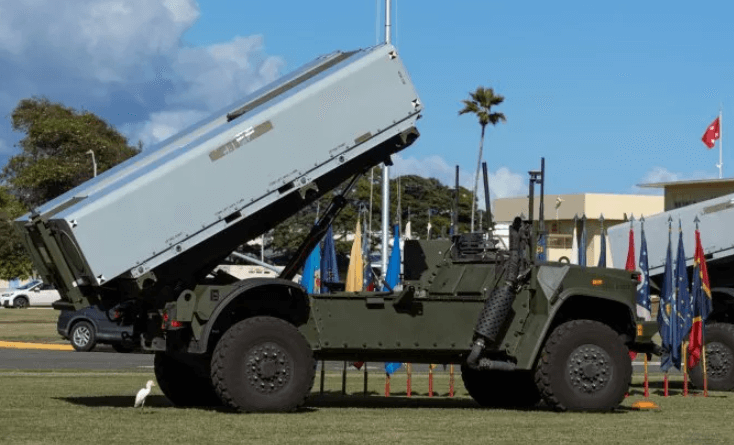
The Navy-Marine Expeditionary Ship Interdiction System is seen at a ceremony on Marine Corps Base Hawaii on November 26, 2024. The system has an anti-ship capability intended to facilitate sea denial and control. Sgt. Jacqueline C. Parsons/U.S. Marine Corps
What Is NMESIS?
NMESIS is a ground-based missile platform integrating Naval Strike Missiles (NSMs) onto unmanned Joint Light Tactical Vehicles (JLTVs). Designed for sea denial and coastal defense, the system has a range of over 100 nautical miles and can target enemy ships with high precision.
Deployment and Purpose
The system arrived in the Philippines before the Balikatan exercises, scheduled from April 21 to May 9, 2025. While the exact deployment location remains undisclosed, officials confirmed that NMESIS will actively participate in the drills. U.S. Defense Secretary Pete Hegseth emphasized that the deployment aims to enhance interoperability and strengthen deterrence capabilities between the U.S. and Philippine forces.
Strategic Significance
Balikatan 2025 will involve approximately 14,000 troops, including 9,000 from the U.S. and 5,000 from the Philippines, along with 200 Australian personnel and observers from Japan, Poland, and the Czech Republic. The exercises will focus on integrated air and missile defense, with key activities planned in strategically important areas such as Palawan and northern Luzon.
The deployment of NMESIS follows the earlier introduction of the U.S. Army’s Typhon missile system to the Philippines, further enhancing the country’s coastal defense capabilities. These developments reflect a concerted effort to bolster regional security and address challenges in the South China Sea and surrounding areas.
Photo: Sgt. Jacqueline C. Parsons/U.S. Marine Corps on Marine Corps Base Hawaii, Nov 2024


