
Cebu and Bohol power Central Visayas economic surge in 2024 with 7.3% GRDP growth
Why is Central Visayas growing so fast in 2024? Who is fueling this progress? What are the drivers behind it? Where is this happening, and how is it being achieved?
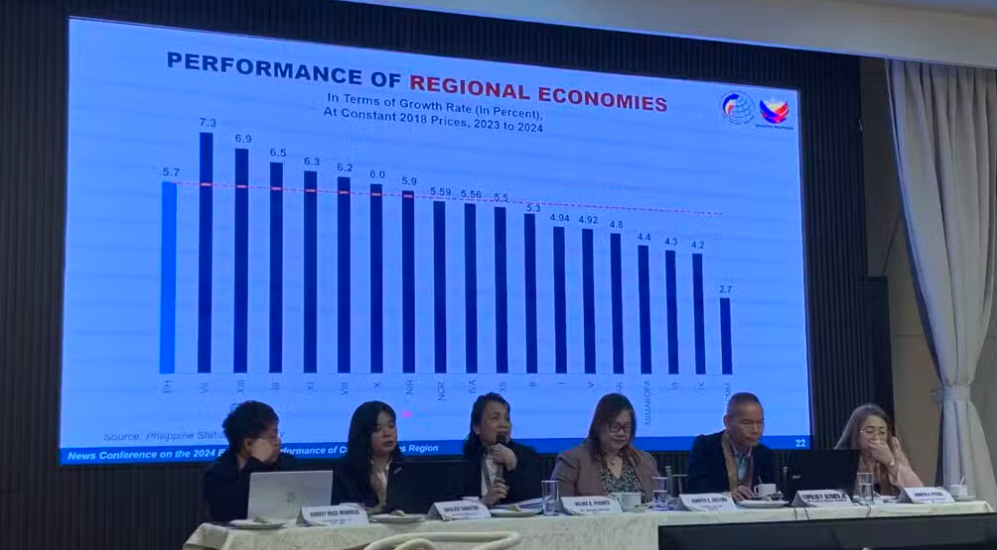
The answers were given during the staging of the 2024 Regional Economic Performance (REP) briefing at the NEDA regional office last April 22 when the regional presentation landed and announced that despite NIR’s secession (withdrawal) of Negros Oriental and Siquijor, Central Visayas, which it owns of only Cebu and Bohol, including the whole island region’s NEDA led percentage in 7.3 percent Gross Regional Domestic Product (GRDP) in 2024.
This increased the combined regional output to ₱1.28 trillion, surpassing the ₱1.19 trillion recorded in 2023 by approximately ₱86.79 billion. The release proved that the region is the fastest across-the-region economy in the Philippines for two years in a row.
Cebu and Bohol as economic anchors in Central Visayas
According to PSA-7 OIC Regional Director Wilma Perante, the economic performance was measured by the output of goods and services produced in the region throughout the year. Despite losing two provinces to the newly established NIR, Cebu and Bohol remained economic powerhouses, carrying the momentum forward.
Perante emphasized that services continued to dominate the economy with a 70.1 percent share, followed by industry at 24.9 percent, and agriculture, forestry, and fishing (AFF) at 5 percent.
Meanwhile, NEDA-7 Director Jennifer Bretaña said Central Visayas’ growth outpaced the national economic growth of 5.7 percent, proving the region’s resilience and adaptability.
“These are also consistent with the higher tourist arrivals and tourist receipts in 2024 than the previous year, 2023, from 5.48 million to 7.15 million, or a 37.3% increase,” Bretaña noted.
The main contributors to the economic upswing were wholesale and retail trade (7.7% growth), manufacturing (6.6%), and financial services (7.1%).
Within sub-industries, tourism emerged as a standout performer. Accommodation and food service activities grew by 14.6 percent, while transportation and storage increased by 11.3 percent—both signs of a thriving tourism sector.
The region also experienced a 37.3 percent increase in tourist arrivals, from 5.48 million in 2023 to 7.15 million in 2024, which boosted local spending and hospitality services.
Government and household spending also played a significant role. Gross capital formation, a key indicator of investment, jumped by 13.8 percent. Household consumption increased by 7.7 percent, with per capita spending rising to ₱140,782, from ₱132,067 in 2023.
Infrastructure and Policy make an impact in Central Visayas
Former Mandaue Chamber of Commerce and Industry (MCCI) President Steven Yu credited the performance to sustained infrastructure projects, improved connectivity, access to energy and water, better ease of doing business, and strong support for education and healthcare.
“These initiatives are bearing fruit and serve as a strong foundation for further economic growth, leapfrogging other regions,” Yu said.
He also noted that airport upgrades and increased flight access have significantly contributed to tourism growth, particularly in Cebu. The Bohol Solar Power Plant and other energy investments were also noted as game changers, particularly for industries that require stable electricity in Central Visayas.
Business leaders were also encouraged by the region’s stable inflation rate, with March 2024 figures pegged at just 2.4 percent, below February’s 2.5 percent and within the government’s target of 2 to 4 percent.
MCCI President Mark Ynoc added that inflation control and strong export growth in electronics and semiconductors helped keep businesses confident and competitive.
Despite the good news, experts acknowledged that challenges remain. Bretana cited global threats, including US tariffs on Philippine exports, the war in Ukraine, and climate-related disruptions such as typhoons, as potential hurdles.
Former US President Donald Trump recently announced a 17 percent tariff on Philippine goods, but business leaders in Central Visayas believe the region is agile enough to weather the changes.
“With new tariff rules in the US and the diversion of discounted Chinese products to ASEAN markets like the Philippines, we expect continued stability in inflation.”
“However, this could put pressure on domestic manufacturers, requiring efficient supply chain management to keep local industries competitive while safeguarding consumer choice,” he added.
As Central Visayas looks ahead to 2025, officials are optimistic. The Regional Development Plan (RDP) for 2023-2028, grounded in the current administration’s eight-point agenda, which encompasses food, energy, healthcare, education, and more, is expected to further propel the region’s momentum.
The upcoming midterm elections are also expected to boost economic activity, with increased spending on campaigns likely to stimulate various sectors.
With the numbers backing them up and the strategies clearly in place, SugBohol’s economic story is one worth watching.
Image Cover: Niña Mae Oliverio
Image Body: Motor7 Central Visayas Adventures Facebook page